|
By Fabius Maximus
November 12, 2006
Rev 8 May 07 to add V. D. Hanson's use of the "Friedman unit"
"The next 90 days are critical" – A sampler of quotes about Iraq
Summary
The situation remains locked, with no visible signs of change. Just more deaths, every day. A brief on the key aspects of the Expedition to Iraq follows.
Analysis
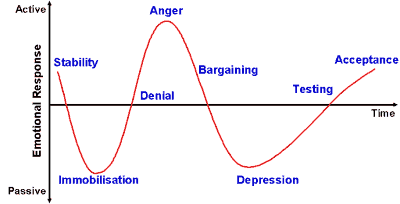
As many 4GW experts forecast, the western nations’ (largely US and UK) Expedition to Iraq was doomed before it began. As such the Kubler-Ross “Death and Dying” process offers the best metaphor for our conduct of the war. 1/
-
Shock & Denial: Initial paralysis at hearing the bad news: trying to avoid the inevitable.
-
Anger: Frustrated outpouring of bottled-up emotion.
-
Bargaining: Seeking in vain for a way out.
-
Depression: Final realization of the inevitable.
-
Testing and Acceptance: Seeking realistic solutions; finally finding a way forward.
America’s elites remained for a long period in Denial, and then moved into Anger. 2/ They directed their anger at anybody other then themselves: Bush/Hitler, Leftist traitors, “Neville Chamberlain’s” in the Democratic Party, Al Qaeda, various elements of the Iraq people, and Iran. There have been, of course, few mea culpa’s from our leaders, Democrat or Republican. 3/
Now we advance to bargaining.
Unfortunately we will bargain in vain, as we have not accepted the inevitability of our defeat. Too many of us have come to think like President Nixon: What President Nixon means by peace is what other people mean by victory. 4/
Seeking victory – even a small one – by negotiating with the true winners seems unlikely to achieve anything but burning more time.
One common expression of this foolishness is the “retreat to the desert” proposal. For example, Stratfor has long recommended that we abandon Iraq’s urban areas (returning only to bomb them as needed) and relocate our forces into massive desert bases. From these we can achieve what they see as our original and primary goal of the invasion: secure bases from which to project military power throughout the Middle East.
Like the invasion itself, this seems poorly conceived, perhaps absurd. Let’s withdraw from the urban battle zones and watch the ethnic and religious groups fight to a conclusion. This might be fast or quick – who knows? There will likely be ethnic cleansing – probably the only that can now bring peace to Iraq – involving few or many deaths. The only certainty: the winners then owes us nothing, and will likely order us out. Just like our previous plans: failure guaranteed in advance – brought to you by the best and the brightest of the American governing class.
Unless we use Kurdistan as a base. That makes a twisted sort of sense, with our chief regional allies then being Israel and Kurdistan -- enemies of everyone else in the region. Hardly steady platforms from which to project power, and no basis for viable diplomatic efforts.
Our slow process through the Kubler-Ross process results from our reluctance to accept reality – its conflict with our belief in America omnipotence and time is our greatest wealth. That is, the belief that events will await our pleasure, that we need not hurry. This remains one of our greatest and most foolish assumptions.
This is a defining moment in Iraq. The next six months will be crucial. Again. And Again.
At the end of this essay are 52 quotes from the members of our ruling elites. Your favorite search engine can easily find the full text for these speeches and articles. I recommend you rely on transcripts and other primary sources, where available,
What conclusions can we draw from this material?
The Democrats recommend we adopt (retain?) an infantile attitude, that of little children focusing on abuse by their big, bad guardians. Blaming Bush might be justified, and is certainly entertaining, but does not help decide what to do next. Whatever mistakes, deceptions, or outright fraud happened back in 2002, we should get over it. Both Coalition soldiers and Iraq civilians die while we dither.
The real lesson of this history seems sadder and more painful to contemplate. We were fools for going along with this slow-motion disaster for so long. If we refuse to change this attitude we should look for more bad news in our future.
It is long past time to re-introduce ourselves to Mr. Reality. We’ve lost, so what do we do next? All choices are bad, but the difference between bad and worse is far more significant than that between good and better. Harsh decisions lie ahead.
The next milestone on this road to Hell is the report of the Iraq Study Group. I have little hope for decisive recommendations from this collection of retired politicos. If they fail us, then we must wait for the American citizenry to wake up and protest.
Things are moving in the Middle East. If we wait too long they might move against us.
And what will the Good and the Great be telling us in six more months?
Wait – It’s not our fault! Who knew that the war was going so badly?
It was obvious. To mention just one source, the reporting and analysis published on DNI by various authors has proven quite remarkable – often prescient.
Other experts also correctly and quickly forecast the outcome. Here are two examples.
|
1. George Friedman of Stratfor, published December 30, 2004.
After the January elections, there will be a Shiite government in Baghdad. There will be, in all likelihood, civil war between Sunnis and Shia. The United States cannot stop it and cannot be trapped in the middle of it. It needs to withdraw.
Certainly, it would have been nice for the United States if it had been able to dominate Iraq thoroughly. Somewhere between "the U.S. blew it" and "there was never a chance" that possibility is gone. It would have been nice if the United States had never tried to control the situation, because now the United States is going to have to accept a defeat, which will destabilize the region psychologically for a while. But what is is, and the facts speak for themselves. …
If Bush has trouble doing this, he should conjure up Lyndon Johnson's ghost, wandering restlessly in the White House, and imagine how Johnson would have been remembered if he had told Robert McNamara to get lost in 1966.
2. Published in The Observer (a UK paper owned by The Guardian News and Media Ltd.) on June 23, 2003.
http://www.commondreams.org/cgi-bin/print.cgi?file=/headlines03/0622-05.htm
…
At the end of a week that saw a war of attrition develop against the US military, General William Nash told The Observer that the US had 'lost its window of opportunity' after felling Saddam Hussein's regime and was embarking on a long-term expenditure of people and dollars for which it had not planned.
'It is an endeavor which was not understood by the administration to begin with,' he said.
Now retired, Nash served in the Vietnam war and in Operation Desert Storm (the first Gulf War) before becoming commander of US forces in Bosnia and then an acclaimed UN Civil Affairs administrator in Kosovo.
'It is much greater and deeper than just the consequences of war,' he added. 'It comes from 12 years of sanctions, Israel and Palestinians, and a host of issues.'
…
'You can't tell who is behind the latest rocket propelled grenade. It could be a father whose daughter has been killed; it could be a political leader trying to gain a following, or it could be rump Saddam. Either way, they are starting to converge.'
…
Nash is reluctant to make comparisons with Vietnam: 'There are far more things that were different about Vietnam than there are similarities. Except perhaps the word "quagmire". Maybe that is the only thing that is the same.'
|
What the author recommends that we do in Iraq …
For a simple solution to Iraq, read the next essay by Fabius Maximus. Coming soon!
Please send comments and corrections to .
A Sampler of Quotes by the Good and the Great about the Iraq War
To commemorate Thomas Friedman's long and consistently wrong series of forecasts about the Iraq War, in May 2006, the blogger "Atrios" defined a "Friedman Unit" as any six month period.
Note: bold emphasis added.
|
[Note: The quotes by Thomas Friedman are from “Tom Friedman's Flexible Deadlines.” May 16, 2006, Fairness & Accuracy In Reporting (FAIR)
http://www.fair.org/index.php?page=2884]
“And it is not knowable if force will be used, but if it is to be used, it is not knowable how long that conflict would last. It could last, you know, six days, six weeks. I doubt six months.”
February 7, 2003
Donald Rumsfeld, then-Secretary of Defense
Speaking at a “TownHall Meeting” held at Aviano Air Base, Italy
"I think the next few months will be crucial."
July 3, 2003
Senator Pat Roberts (Republican - Kansas)
"Looking at what we have today in Iraq and also in Afghanistan, and looking at the whole region and how infectious it can be for positive or for widespread trouble in the world, I think we may be going through a series of weeks and months that are crucial to the future history of freedom and stability. The determination of the British people, the Royal Airforce (RAF) and the Battle of Britain and Dunkirk success, if it was a success, probably saved not just Britain, but the Western world at that time. I am convinced that there is going to have to be a determination by the American people, military, particularly American military, quality and quantity, not just presence but capability, and a confidence in the Iraqi people that they can have a stable and representative government.
July 10, 2003
Representative Ike Skelton (Democrat - Missouri)
Speaking at a hearing of the House Armed Services Committee
[Question: When you speak of victory, how do you define it today in Iraq?]
MCCAIN: Probably when the people of Iraq are governing themselves. That's probably the best benchmark, and that probably could happen sooner rather than later, as far as being directly related to the return of the basic services – the electricity, the water, the sanitation, the law enforcement – those kinds of things. … And I'm not sure how long it would be, but I don't think that we have time on our side. I think it's critical that we act quickly by sending more troops there. And if not, we run the risk of the Iraqi people turning against us.
[Question: Are you thinking 6 to 12 months? Or do you think that's dreaming at this point?]
MCCAIN: I don't know because I don't know how quickly we're going to act in the form of sending troops. I don't know how quickly we're going to be able to provide them with the security. So, it's sort of up to us. But I would argue that the next three to six months will be critical.
September 10, 2003
Sen. John McCain (Republican - Arizona)
Speaking on CNN’s “American Morning”
"The next six months in Iraq – which will determine the prospects for democracy-building there – are the most important six months in U.S. foreign policy in a long, long time."
November 30, 2003
Thomas Friedman, New York Times foreign affairs columnist
"The next six to seven months are critical."
December 1, 2003
Senator Hillary Rodham Clinton (Democrat - NY)
Quoted in the Washington Post on November 30, 2005
"The important thing is to realize we are about to enter into a very critical six months … We have got to get on top of the security situation properly and we have got to manage the transition. Both of those things are going to be difficult."
January 4, 2004
UK Prime Minister Tony Blair
Speaking during a surprise visit to Iraq
"Iraq now faces a critical moment."
May 24, 2004
President Bush
Speaking at the United States Army War College
"What I absolutely don't understand is just at the moment when we finally have a UN-approved Iraqi-caretaker government made up of – I know a lot of these guys – reasonably decent people and more than reasonably decent people, everyone wants to declare it's over. I don't get it. It might be over in a week, it might be over in a month, it might be over in six months, but what's the rush? Can we let this play out, please?"
June 3, 2004
Thomas Friedman, New York Times foreign affairs columnist
Speaking on National Public Radio’s “Fresh Air”
“The next few months will be critical as the new government must establish security, continue to rebuild Iraq’s infrastructure, and prepare the Iraqi people for national elections scheduled for January 2005.”
July 22, 2004
Senator Richard G. Lugar (Republican – Indiana)
Statement to the Senate Foreign Relations Committee
"What we're gonna find out, Bob, in the next six to nine months is whether we have liberated a country or uncorked a civil war."
October 3, 2004
Thomas Friedman, New York Times foreign affairs columnist
Speaking on CBS's “Face the Nation”
"Improv time is over. This is crunch time. Iraq will be won or lost in the next few months. But it won't be won with high rhetoric. It will be won on the ground in a war over the last mile."
November 28, 2004
Thomas Friedman, New York Times foreign affairs columnist
“There are rare occasions when two distinct geopolitical processes reach a pivot point at the same time, that precise place where the evolution of a process takes a critical turn. Last week saw three such points. In Iraq, the security network around the guerrilla leadership appeared to be breaking wide open.”
March 1, 2005
George Friedman, Stratfor
“As the political process evolves, further government victories could be in the offing. Intense negotiations on the formation of the Cabinet, involving the United Iraqi Alliance, Kurdish List, Sunnis and other factions, have already begun. With Sunnis incorporated into a new government, progress on the political front likely will lead to further success on the battlefield as U.S. and Iraqi forces continue to keep pressure on the insurgents with raids, arrests and all-out offensive operations. These developments ultimately will support the U.S. strategy of turning the combat burden over to an emboldened and maturing Iraqi army.”
March 23, 2005
Stratfor
“Washington has moved beyond the military stage of the U.S.-jihadist war and is now in the phase of negotiated settlements.”
April 6, 2005
Stratfor
"I think the next nine months are critical."
June 29, 2005
Zalmay Khalilzad, U.S. Ambassador to Iraq
Speaking on National Public Radio’s “All Things Considered”
“This attack probably will be instrumental in turning the Iraqis against the militants, especially the transnational jihadists who are not only seen as using the general insurgency in Iraq for their cause (which has very little to do with the Sunni community's grievances or Iraqi nationalism), but now seem to have reached the point where they will not shirk from killing children as part of their attack plans.”
July 13, 2005
Stratfor
“I think the next 18 months are crucial."
July 18, 2005
General Barry R. McCaffrey, retired
Quoted in the Washington Post on November 30, 2005
“I have long been invested with ensuring the development of a peaceful, democratic Iraq. We are nearing the resolution of that process, and the next months will be critical.”
August 4, 2005
Ambassador John Bolton, U.S. Permanent Representative to the United Nations
Statement to the Security Council
“But the fact is these next six months are going to be very critical in Iraq, not just the constitution writing, referendum, the election, but also within that six months' period, we're going to see whether the Iraqis are really going to be capable of defending themselves, governing themselves and supporting themselves.”
August 18, 2005
Senator Chuck Hagel (Rep- Nebraska)
Speaking on CNN’s “Situation Room”
"I think we're in the end game now…. I think we're in a six-month window here where it's going to become very clear and this is all going to pre-empt I think the next congressional election – that's my own feeling – let alone the presidential one."
September 25, 2005
Thomas Friedman, New York Times foreign affairs columnist
Speaking on NBC's “Meet the Press”
“The next 75 days are going to be critical for what happens”
September 29, 2005
General George Casey, Commanding General of coalition forces in Iraq
Testimony to the Senate Armed Services Committee
"… Maybe the cynical Europeans were right. Maybe this neighborhood is just beyond transformation. That will become clear in the next few months as we see just what kind of minority the Sunnis in Iraq intend to be. If they come around, a decent outcome in Iraq is still possible, and we should stay to help build it. If they won't, then we are wasting our time."
September 28, 2005
Thomas Friedman, New York Times foreign affairs columnist
“And the developments over the next several months will be critical – as General Casey and General Abizaid and the secretary made very clear over the course of last week – as the constitutional referendum in the mid part of this month, the general elections in mid-December and then the subsequent formation of a new government all take place.”
October 5, 2005
Lt. Gen. David Petraeus, Former Commander, Multi-National Transition Command Iraq and NATO Training Mission Iraq
News Briefing
As always, whenever the Bush administration helps to pull off an election in Iraq, you have to hand it to them. Poor job on occupation, no doubt, but this thing keeps muddling through. … Meanwhile, a lot of Sunnis are shifting from fighting the system altogether to working within the political process. This is crucial. … Iraq is doing just fine given all poorly planned occupation (F to the neocons, C+ to the officers doing their best in a crappy situation on the ground).
October 17, 2005
Thomas P. M. Barnett
“We are entering a make or break six month period, and I want to talk about the steps we must take if we hope to bring our troops home within a reasonable timeframe from an Iraq that's not permanently torn by irrepressible conflict. …
“To those who suggest we should withdraw all troops immediately – I say No. A precipitous withdrawal would invite civil and regional chaos and endanger our own security. But to those who rely on the overly simplistic phrase "we will stay as long as it takes," who pretend this is primarily a war against Al Qaeda, and who offer halting, sporadic, diplomatic engagement, I also say – No, that will only lead us into a quagmire. …
“To undermine the insurgency, we must instead simultaneously pursue both a political settlement and the withdrawal of American combat forces linked to specific, responsible benchmarks. At the first benchmark, the completion of the December elections, we can start the process of reducing our forces by withdrawing 20,000 troops over the course of the holidays. …”
October 26, 2005
Senator John Kerry (Democrat – Mass)
Speech at Georgetown University
“And we're seeing a lot of them [officials from the Iraqi government] because this is a critical time in Iraq going into the elections, and it is very important that these elections produce an outcome, that it reflects the will of the Iraqi people, that results in a government – that is broadly based, drawing from all elements of the Iraqi society, that gets stood up quickly and is a strong government that can take the kinds of difficult, economic and security decisions that the new government is going to have.”
November 10, 2005
Steve Hadley, National Security Advisor
Comments at White House Press Briefing
"We've got, I think, six months."
Nov. 17, 2005
Senator John W. Warner (Republican -Virginia)
Quoted in the Washington Post on November 30, 2005
“Instead, we need to refocus our attention on our mission — of our mission on preserving America’s fundamental interests in Iraq. And there are two of them, in my view. One, we must ensure that Iraq does not become what it was not before the war — emphasize “was not before the war” — a haven for terrorists, a jihadist stronghold. And we must do what we can to prevent a full-blown civil war that runs the risk of turning into a regional war. To accomplish that more limited mission and to begin redeploying our troops responsibly, it seems to me we have to make significant, measurable progress toward three goals, and you only have about the next six months to demonstrate that progress.”
November 21, 2005
Senator Joseph Biden (Democrat - Delaware)
Speaking at the Council on Foreign Relations
“What the debate is telling us is that we have come to a defining moment in the war and in U.S. policy toward the war. … The administration's position in Iraq is complex but not hopeless. Its greatest challenge is in Washington, where Bush's Republican base of support is collapsing. If it collapses, then all bets will be off in Iraq. Bush's challenge is to stabilize Washington. In fact, from his point of view, Baghdad is more stable than Washington right now. …”
November 21, 2005
George Friedman of Stratfor
“I served in the last year of World War II in the Navy. Franklin D. Roosevelt did just exactly that. In his fireside talks, he talked with the people, he did just that. I think it would be to Bush's advantage. It would bring him closer to the people, dispel some of this concern that understandably our people have about the loss of life and limb, the enormous cost of this war to the American public, and we've got to stay firm for the next six months. It is a critical period, as Joe and I agree, in this Iraqi situation to restore full sovereignty in that country and that enables them to have their own armed forces to maintain their sovereignty. …
[Question: “What happens if not enough Iraqis step forward to defend their country?”]
“At that point then we have to come to the realization that the program has not met the target and we have to determine what we're going to do. I would not want to posture what that decision would be. You'll have to wait. You shouldn't speculate. We'll have to wait for those six months.”
November 27, 2005
Senator John W. Warner (Republican -Virginia)
Speaking on NBC’s “Meet the Press”
“But it was necessary for the president to go out and reinforce to our troops and the other coalition forces and to the world that we have a resolve in these next four to six months in Iraq which are critical to bring about achievement of our goals. … We should not at this time in these critical four to six months be worrying about a timetable to withdraw or even talking about it.”
November 30, 2005
Senator John W. Warner (Republican -Virginia)
PBS “Online Newhour”
"[The Iraq elections are] necessary, not sufficient … [the] next six months are going to tell the story. Two important things. What’s the government going to look like? If it’s Mr. Mahdi who ends up representing the SCIRI Party, who’s aligned with Iran, then we got a real problem.
December 18, 2005
Senator Joseph Biden, Jr. (Democrat - Delaware)
Speaking on CBS’ “Face the Nation”
"We've teed up this situation for Iraqis, and I think the next six months really are going to determine whether this country is going to collapse into three parts or more or whether it's going to come together."
December 18, 2005
Thomas Friedman, New York Times foreign affairs columnist
Speaking on CBS’ “Face the Nation”
"We're at the beginning of I think the decisive I would say six months in Iraq, OK, because I feel like this election – you know, I felt from the beginning Iraq was going to be ultimately, Charlie, what Iraqis make of it."
December 20, 2005
Thomas Friedman, New York Times foreign affairs columnist
Speaking on PBS's Charlie Rose Show
"The only thing I am certain of is that in the wake of this election, Iraq will be what Iraqis make of it – and the next six months will tell us a lot. I remain guardedly hopeful."
December 21, 2005
Thomas Friedman, New York Times foreign affairs columnist
“We have reached a crucial test in Iraq. … Whatever the explanation, this is the crucial moment. The elections were held and a political track was set. If this offensive derails the negotiations, it will be a defining moment in the war. If the negotiations go forward anyway – for any of the reasons discussed above – then the probability of a drawdown in the war in 2006 is very real. In the end, the reasons for the offensive are less clear than its potential significance. As they say, this is it.”
January 6, 2006
Stratfor
"I think that we're going to know after six to nine months whether this project has any chance of succeeding. In which case, I think the American people as a whole will want to play it out or whether it really is a fool's errand."
January 23, 2006
Thomas Friedman, New York Times foreign affairs columnist
Speaking on the Oprah Winfrey Show
"I think we're in the end game there, in the next three to six months, Bob. We've got for the first time an Iraqi government elected on the basis of an Iraqi constitution. Either they're going to produce the kind of inclusive consensual government that we aspire to in the near term, in which case America will stick with it, or they're not, in which case I think the bottom's going to fall out."
January 31, 2006
Thomas Friedman, New York Times foreign affairs columnist
Speaking on CBS; program is uncertain and not been verified.
"I think we are in the end game. The next six to nine months are going to tell whether we can produce a decent outcome in Iraq."
March 2, 2006
Thomas Friedman, New York Times foreign affairs columnist
Speaking on NBC's “Today”
“Ashraf Qazi, the Secretary-General’s Special Representative for Iraq, told the Security Council in an open briefing this morning that the next six months in Iraq are going to be critical.”
March 15, 2006
http://www.un.org/News/ossg/hilites/hilites_arch_view.asp?HighID=522
“If there is ever going to be an end game in Iraq, we are now in it. Operation Swarmer, launched Thursday, seemed designed to attack jihadists in the Sunni regions. The key to the U.S.-Sunni conversation has been getting the Sunnis into the political process and, as a result, getting the Sunnis to help liquidate the jihadists. If Swarmer was launched on the basis of Sunni intelligence, and if that intelligence turns out to be accurate, it will be a key event in recent Iraqi history. Those are big "ifs," of course. At the same time, if the Sunnis are joining the political process, then it is time for Iran to negotiate its final price on Iraq, and that appears now to be happening. Taken together, this is not the end, but the beginning of the end game, and success is not guaranteed.”
“The Beginning of the End Game”
Mar 17, 2006
Stratfor
"Can Iraqis get this government together? If they do, I think the American public will continue to want to support the effort there to try to produce a decent, stable Iraq. But if they don't, then I think the bottom is going to fall out of public support here for the whole Iraq endeavor. So one way or another, I think we're in the end game in the sense it's going to be decided in the next weeks or months whether there's an Iraq there worth investing in. And that is something only Iraqis can tell us."
April 23, 2006
Thomas Friedman, New York Times foreign affairs columnist
Speaking on “CNN Late Edition with Wold Blitzer”
"Well, I think that we're going to find out, Chris, in the next year to six months – probably sooner – whether a decent outcome is possible there, and I think we're going to have to just let this play out."
May 11, 2006
Thomas Friedman, New York Times foreign affairs columnist
Speaking on MSNBC's “Hardball”
“We would say that the next six weeks, rather than months, will show us where things are.”
“Core Issues in Iraq”
May 22, 2006
Stratfor
“The violence in Iraq will surge, but by July 4 there either will be clear signs that the Sunnis are controlling the insurgency – or there won't. If they are controlling the insurgency, the United States will begin withdrawing troops in earnest. If they are not controlling the insurgency, the United States will begin withdrawing troops in earnest. Regardless of whether the deal holds, the U.S. war in Iraq is going to end: U.S. troops either will not be needed, or will not be useful. Thus, we are at a break point – at least for the Americans.”
“Break Point”
May 23, 2006
George Friedman, Stratfor
“The next six months will be critical in terms of reining in the danger of civil war. If the government fails to achieve this, it will have lost its opportunity.”
June 7, 2006
Zalmay Khalilzad, US Ambassador to Iraq
Interviewed in Der Spiegel
“Second, international oil companies have been waiting for two things before investing in the Iraqi oil complex: a domestically chosen, internationally acceptable representative government, and an end to the insurgency. The first has happened; the second may finally be in sight.”
“Iraq: The Implications of Al-Zarqawi's Death”
June 08, 2006
Stratfor
“If we are right and this is the tipping point, then things just tipped toward a political settlement. This will become clearer over the next few days. Violence will certainly not disappear, but it should reduce itself rather rapidly if the Sunni and Shiite leadership have put out the word. We thought this was the week for something to happen, and something has. Now to find out if it was what we were waiting for, and to find out if it will work.”
Jun 09, 2006
“Al-Zarqawi and the Tipping Point”
Stratfor
“This is a decisive period for everyone and everyone knows it. The next six months will determine the future of Iraq.”
October 5, 2006
General George Casey, Commanding General of coalition forces in Iraq
Official statement after a 39-nation meeting in Warsaw to discuss “the challenges facing Iraq and the US-led coalition."
"Time is short, level of violence is great and the margins of error are narrow. The government of Iraq must act. The government of Iraq needs to show its own citizens soon and the citizens of the United States that it is deserving of continued support. The next three months are critical. Before the end of this year, this government needs to show progress in securing Baghdad, pursuing national reconciliation and delivering basic services."
September 19, 2006
Lee Hamilton, former Congressman (Democrat – Indiana), member of the Iraq Study Group
“The next six months are likely to be critical in determining whether the situation in Iraq turns worse or whether we may yet salvage a measure of political stability that addresses our long-term security interests in the region.“
Rep. Mark Udall (Democrat - Colorado)
June 22, 2006
The war will be won or lost, like it or not, fairly or unjustly, in the next six months in Baghdad.
Victor Davis Hanson,
"All Eyes on Baghdad"
May 2, 2007
|
Endnotes
1/ This summary and the graphic come from The Kübler-Ross grief cycle at http://changingminds.org/disciplines/change_management/kubler_ross/kubler_ross.htm
For more information see the http://en.wikipedia.org/wiki/Five_Stages_of_Grief
2/ This is a generality, and of course there are exceptions. Perhaps the most notable is the speech of Rep. John P. Murtha (Democrat - Pennsylvania) on November 17, 2005. This concluded with “IT IS TIME TO BRING THEM HOME.” For a list of other recommendations to withdraw, see http://www.comw.org/pda/0512exitplans.html.
3/ Here are two examples of those rare individuals who admit error and take responsibility. On August 17 of 2006 former Senator John Edwards said, “I voted for this war. I was wrong. … I should not have voted for this war and I take responsibility for that." Also note the exceptional actions and words of Marine Lieut. General Greg Newbold, the Pentagon's top operations officer from 2000-2002: http://www.time.com/time/magazine/article/0,9171,1181629-1,00.html.
4/ Don Oberdorfer of the Washington Post, 1972, quoted in the last chapter of David Halberstam’s The Best and the Brightest.
About this series of articles on grand strategy.
There are few comprehensive proposals for a grand strategy for America in the literature of either the "Revolution in Military Affairs" or of 4th Generation War. This series presents an alternative to Thomas P.M. Barnett's "Pax Americana" vision. It is based on, and in a sense starts from, William Lind’s “Strategic Defense Initiative” originally published in The American Conservative, November 22, 2004.
Link to Lind’s article: http://d-n-i.net/lind/lind_strategic_defense.htm
Chapter One: “The Myth of Grand Strategy”
This describes the reasons why a developed State should choose a “humble” Grand Strategy, not an “ambitious” one
Chapter Two: “The Fate of Israel”
This demonstrates the difficulty of distinguishing strong from weak in 4GW, and that choosing a wrong grand strategy can be terminal for a state.
“An Interruption – “Top Secret US Government Documents about Iraq”
Comparisons of Vietnam and Iraq suggest that US Government institutions have become dysfunctional, incapable of faithfully and competently executing any Grand Strategy.
Chapter Three: “America’s Most Dangerous Enemy”
Why we must remain cool and careful when assessing threats to America. Our worst enemy is not whom you think it is.
Watch DNI for the new few chapters proposing A Grand Strategy for America.
The US is weak in several vital dimensions. From this it follows that a strategy focused on defense is best, so we can conserve our strength and rebuild while we adapt to a this new era.
Appendices
Who was Fabius Maximus?
|
Fabius Maximus was the Roman leader who saved Rome from Hannibal by recognizing its weakness, the need to conserve and regenerate. He turned from the easy path of macho “boldness” to the long and difficult task of rebuilding Rome’s strength and greatness. His life holds profound lessons for 21st Century America.
|
Qualifications of the Author?
Read the past articles by Fabius Maximus. A work of intellectual analysis stands on its own logic, supported by the author’s track record.
Return to DNI
|